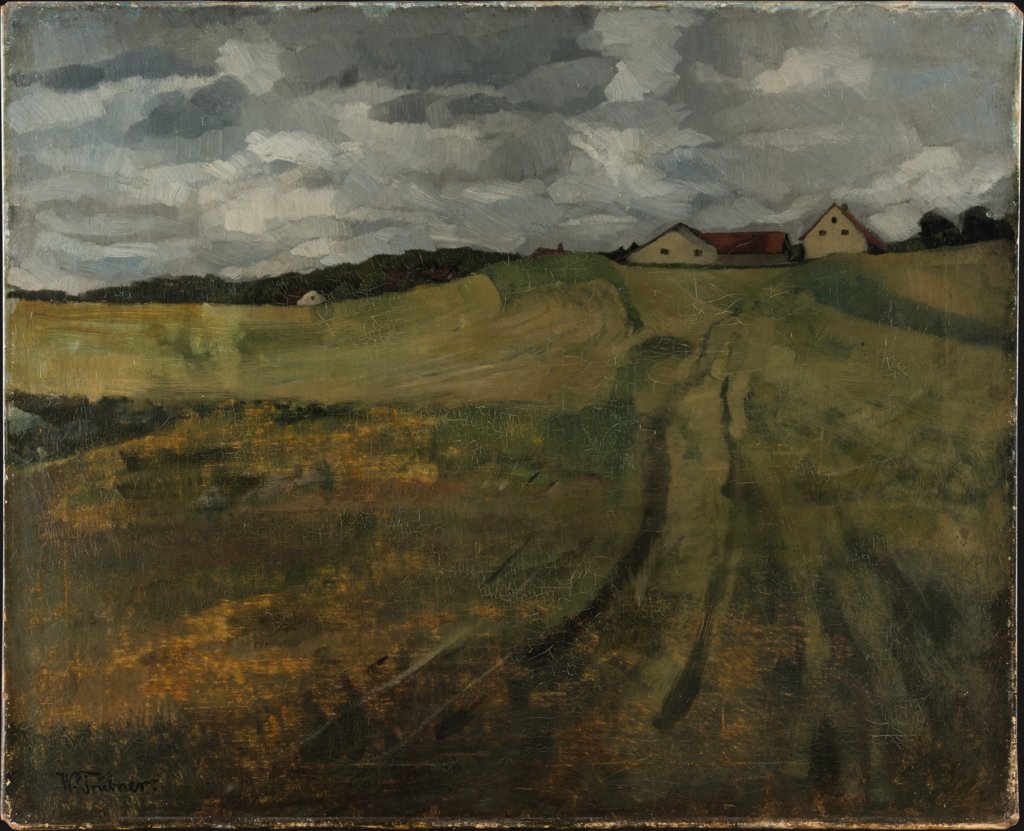
Carl Schuch was born into a well-off family in Vienna in 1846. He received drawing lessons and, from 1865, studied for two semesters at the Academy of Fine Arts Vienna. Shortly thereafter he took lessons from the landscape painter Ludwig Halauska (1827–1882); together they often worked en plein air. In 1869, Schuch participated for the first time in an exhibition. After both his parents and sister had died, he left Vienna that same year to go on his first tour of Italy. In the spring of 1871, Schuch arrived in Munich, where he met Wilhelm Trübner and shortly after also Wilhelm Leibl. Schuch worked in this artistic milieu for approximately five years, interrupting his stay with travels to Germany and Austria as well as Italy, Belgium, the Netherlands, and presumably Paris. By 1876 at the latest, Schuch turned to painting still lifes, which together with landscapes make up the bulk of his work. In the autumn of 1876, Schuch moved to Venice, where he set up a representative studio for himself. In 1877, he exhibited his work for the last time. Schuch continued his travels, especially during the summer months. In 1878, 1880 and 1881, he worked together with his later biographer Karl Hagemeister in the Magraviate of Brandenburg. There, he painted numerous landscapes and his palette became lighter. In November 1882, Schuch moved to Paris where he keenly studied the multifaceted art scene. During the summer, he travelled to Holland, and between 1886 and 1892/3 to the Saut du Doubs, where he painted his most important landscapes. In 1894, Schuch returned to Vienna. He succumbed to a venereal disease in 1903.